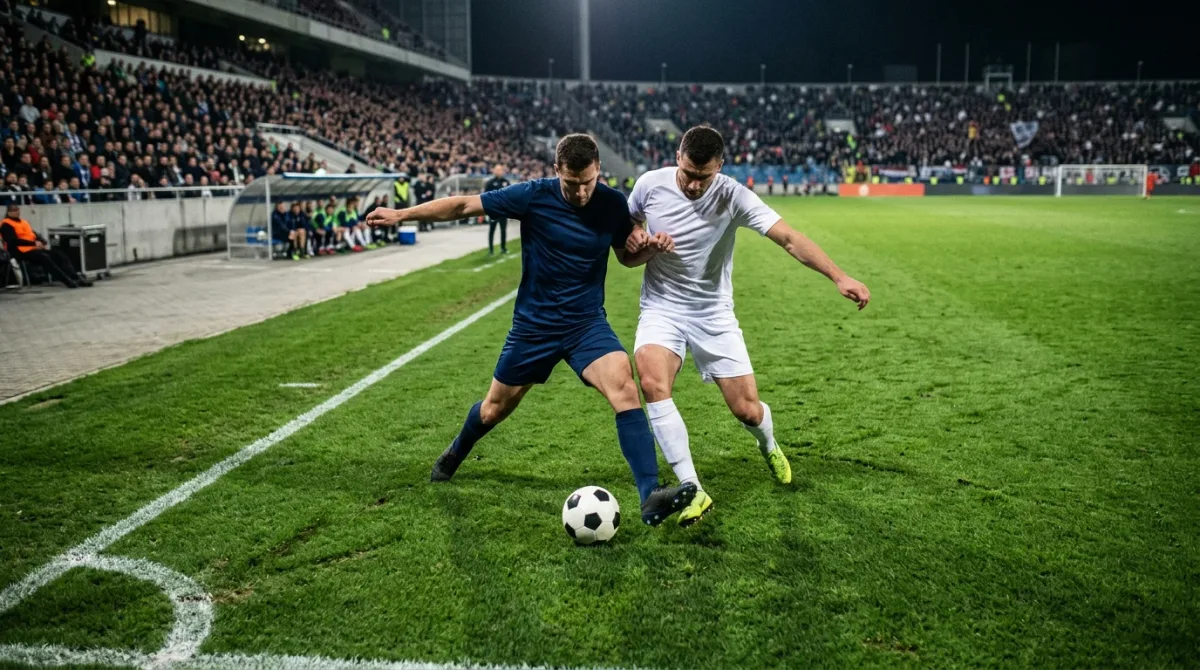
Training compensation and the solidarity mechanism are two FIFA payment systems that route money from a player's transfer back to the clubs that developed him between ages 12 and 23 — the solidarity share fixed at 5% of any transfer fee, under FIFA's Regulations on the Status and Transfer of Players (RSTP).
Both mechanisms sit inside the same regulatory framework, but they trigger at different moments and pay different clubs. Training compensation is a one-time payment tied to a young player's first steps into professional football; the solidarity contribution recurs across a player's entire career, every time he changes clubs for a fee. Understanding the difference matters for any reader trying to follow why an academy — in the United States (“soccer” clubs included) or anywhere else — has a financial stake in a transfer that, on the surface, involves two entirely different teams.
What is training compensation, and when is it owed?
Training compensation is paid when a player signs his first contract as a professional, and again on each transfer up to the end of the season of his 23rd birthday, to every club that contributed to his training since age 12. FIFA describes the mechanism, codified in Article 20 and Annexe 4 of the RSTP, as a reward to clubs “investing in the training and education of young players.” The exact amount depends on the category of the signing club and the confederation in which the training club sits, calculated per year of training. When Major League Soccer moved to observe the rule in 2019, the figures at stake were concrete: a European top-tier club signing a player trained at an MLS academy owed roughly €90,000 per year of training, while a top Confederation of North, Central America and Caribbean Association Football club owed roughly $40,000 per year, for training years between ages 12 and 21.
How does the solidarity mechanism work?
The solidarity contribution, set out in Article 21 and Annexe 5 of the RSTP, works on a different trigger: any time a professional transfers for a fee, 5% of that fee is deducted and distributed among every club that trained him between the ages of 12 and 23, in proportion to the time he spent registered there. Unlike training compensation, which is capped to moves before age 23 and tied to a first professional registration or subsequent transfer, the solidarity share applies across a player's whole transfer history — a club that developed a player as a young academy graduate can still receive a share of a fee paid for him a decade later, provided the transfer involves a fee and crosses registration between clubs bound by the regulations.
Why did Major League Soccer start observing these rules?
For years, U.S. Soccer did not apply training compensation or solidarity payments domestically, citing concerns that the mechanism could run into American child labor law and antitrust exposure. That left MLS academies unpaid when their products moved abroad. The cost of that gap became visible through a run of transfers in the mid-2010s: Weston McKennie left FC Dallas for Schalke 04, and academy products including Haji Wright and Alex Mendez from the LA Galaxy, Andrew Gutman from the Chicago Fire, and Matthew Olosunde from the New York Red Bulls all moved to clubs abroad without their MLS academies receiving training reward payments. In April 2019, MLS announced it would begin observing FIFA's regulations for international moves involving academy-trained players, with the money kept entirely by the individual academy rather than pooled by the league. MLS executive vice president of player relations Todd Durbin said at the time that the league intended “on continuing to make that investment and we want to grow that investment” in youth development. The MLS Players Association opposed the shift, calling it “a step backward for the development of soccer in the United States and Canada” and arguing it would restrict, rather than expand, player mobility abroad. Two clubs, D.C. United and Minnesota United, were initially excluded from receiving payments until their academies met MLS's own funding requirements.
What does the FIFA Clearing House do?
The FIFA Clearing House is the body FIFA built to administer both mechanisms at scale. Endorsed by the FIFA Council in October 2018 as part of a broader package of transfer-system reforms, it centralizes, processes and automates training compensation and solidarity contribution payments between clubs worldwide, with the stated aim of improving financial transparency and reducing fraudulent claims in the transfer system. FIFA describes the payment process as running in three stages: identifying which clubs are entitled to a training reward, compiling an electronic player passport that documents a player's registration history club by club, and then settling payments between the clubs once that passport has been reviewed with the clubs and member associations involved. FIFA states that the total amount distributed to training clubs each year has grown significantly since the Clearing House began operating.
Frequently asked questions
Does a transfer fee have to be paid for the solidarity mechanism to apply?
Yes. The solidarity contribution is calculated as 5% of an actual transfer fee; if a player moves as a free agent with no fee changing hands, there is no solidarity payment to distribute, because the calculation has no fee to draw from.
Why did MLS wait until 2019 to start honoring these payments?
U.S. Soccer had previously declined to apply the mechanism domestically over concerns it could conflict with American child labor law and antitrust rules; MLS's 2019 move applied the regulations specifically to international transfers of academy-trained players rather than domestic moves.
Who keeps the money when an MLS academy receives a payment?
Under MLS's 2019 policy, training compensation and solidarity payments are retained by the individual academy that trained the player, rather than pooled across the league, with the stated purpose of funding further player development at that academy.
What problem was the FIFA Clearing House built to solve?
Before its creation, training clubs often had to identify their own entitlement to a payment and pursue it directly, with disputes common. The Clearing House automates identification, documentation and settlement of these payments and reports rising distributions to training clubs since it began operating.
For a related analysis perspective, read How Arsenal's inverted full-back turned defence into a title-winning platform.
For more context, read How UEFA's squad cost rule now caps club spending at 70%.