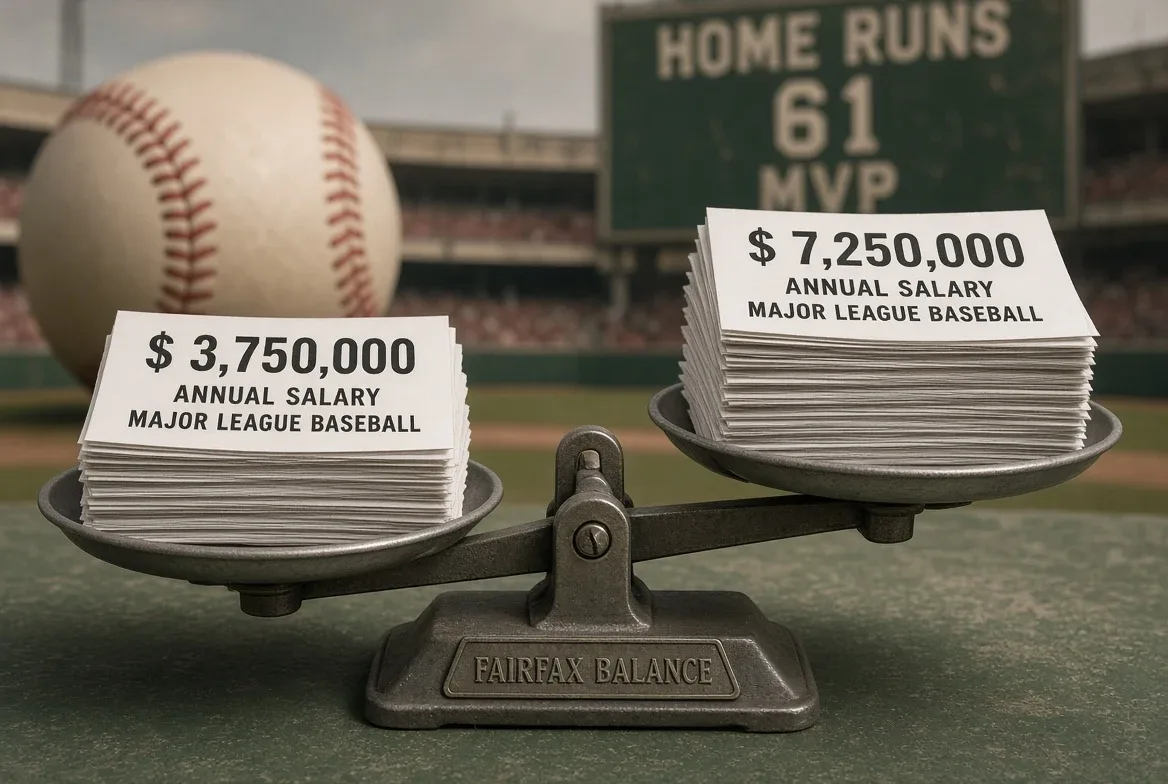
A player and his team who can't agree on a salary don't split the difference — a panel picks one side's number, whole, with nothing in between. In February 2026 alone, catcher Yainer Diaz beat the Houston Astros' $3 million filing and walked away with $4.5 million, while pitcher Kyle Bradish won his case against Baltimore for $3.55 million. That all-or-nothing structure is the whole point.
It sounds like a courtroom drama, and for one week every winter it basically is one. But the mechanics behind it are less mysterious than the hearings make them look, and they explain a good chunk of how rosters get built, why some players get traded in November instead of extended, and why a guy hitting arbitration for the first time suddenly has an agent quoting his defensive metrics like scripture.
Who Actually Qualifies for Arbitration?
A player becomes arbitration-eligible once he has three years of Major League service time and hasn't already signed a contract for the coming season, according to MLB's own glossary. Service time isn't measured in seasons in some loose sense — it's counted in days, with 172 days constituting a full year on the clock. Cross that three-year threshold, and a team can no longer simply set your salary; you get a say, even if the two of you can't agree on the number.
There's a wrinkle that decides careers on the margins: "Super Two" status. A player with between two and three years of service qualifies for an extra year of arbitration — four cycles instead of three — if he ranks in the top 22 percent of service time among players in that band and has at least 86 days of service from the prior season. That's the rule that turns September call-up timing into a strategic decision for front offices, because a few weeks of service time can be the difference between three trips through arbitration and four.
Once a player is in, he stays in every offseason he's tendered a contract, all the way up to six years of service — the point at which free agency opens up and arbitration stops being relevant to him entirely.
What Happens After the Figures Get Exchanged?
If a club and player haven't agreed to a salary by mid-January, both sides file their number with the league. From that point, the two figures are public, and everyone — beat writers, fans, the player's next opponent — knows exactly what the argument is about. Negotiations don't stop just because the figures are out; plenty of cases settle in the weeks after filing, before anyone sets foot in a hearing room.
The ones that don't settle go to a hearing, typically in February. A panel — not a judge, not the commissioner's office — listens to both sides make their case using performance, salaries of comparable players, and other established criteria, then rules for one figure or the other. No averaging, no meeting in the middle. MLB's official glossary lays out that binary structure plainly: the panel picks a side.
Why Doesn't the Panel Just Split the Difference?
Because splitting the difference would remove the one thing that keeps both sides honest. If a team knew it could always land halfway between its number and the player's, it could file absurdly low and still come out ahead on average. Same logic applies to a player's agent filing unrealistically high. The either-or system punishes overreach in both directions, which is exactly why so many cases settle before a hearing ever happens — nobody wants to be the side an arbitrator decides was being unreasonable.
Diaz's win is a clean example of the incentive working as designed. His camp filed at a number the panel found more defensible than the Astros' $3 million, and the gap between the two figures — a million and a half dollars — is the cost of guessing wrong in a system with no partial credit. Bradish's case against the Orioles played out the same way: the club's number lost.
How Is This Different From a Qualifying Offer?
Arbitration and the qualifying offer get confused because both involve a team and player fighting over a single dollar figure, but they apply to completely different players. Arbitration governs players with three to six years of service who are still under their original team's control. The qualifying offer is a tool for players who are already free agents — it lets a team that's about to lose one attach draft-pick compensation to the departure, and the number isn't negotiated at all. Per MLB's glossary, it's set as the mean salary of the league's 125 highest-paid players, which worked out to $22.025 million for the 2026 offseason. A player can simply accept that guaranteed one-year deal, or turn it down and test the open market.
The two systems sit at opposite ends of a player's rise toward free agency: arbitration keeps a rising player's salary tethered to his old team's control for three seasons, and the qualifying offer shows up right as that control finally ends.
Where a Player Sits on the Service-Time Clock
| Service Time | Salary Status | Who Sets the Number |
|---|---|---|
| 0–2 years (or short of Super Two) | Pre-arbitration | The club, largely unilaterally |
| 2–3 years, Super Two qualified | Arbitration-eligible early | Negotiation, or a panel |
| 3–6 years | Arbitration-eligible | Negotiation, or a panel |
| 6+ years | Free agent | The open market |
That table is the real reason arbitration matters to a fan watching from outside the negotiating room. It's the bridge between a rookie making close to the league minimum and a veteran hitting the open market for the first time — and it's why the offseason transaction wire fills up every February with numbers that look small next to a max contract but represent the first real leverage a player has ever had over his own paycheck.
Frequently Asked Questions
- Can a team just release an arbitration-eligible player to avoid paying more? Yes — teams aren't required to tender a contract to an arbitration-eligible player. If they choose not to, the player becomes a free agent immediately rather than going through a hearing.
- Does a hearing loss end a player's arbitration eligibility? No. Per MLB's glossary, a player stays in the arbitration cycle every offseason he's tendered a contract, all the way up to six years of service — one hearing's outcome doesn't remove him from the next year's process.
- Why do so few arbitration cases actually reach a hearing? Because the all-or-nothing structure makes an unreasonable filing risky for both sides, most cases settle once the two figures are exchanged and the gap becomes visible to everyone.
- How is "a year" of service time counted? MLB's glossary defines it as accruing 172 days of Major League service in a given season — the threshold that has to be crossed three times before a player reaches arbitration, and six times before he reaches free agency.
For a related business news perspective, read How the NFL Salary Cap Actually Turns TV Money Into Player Paychecks.
For more context, read Why NFL 'Voluntary' Workouts Aren't Really Voluntary At All.
For more context, read How the 12-Team Playoff Actually Decides Who Gets In.
For more context, read Why ESPN Made Less Money From a Record NBA Season.