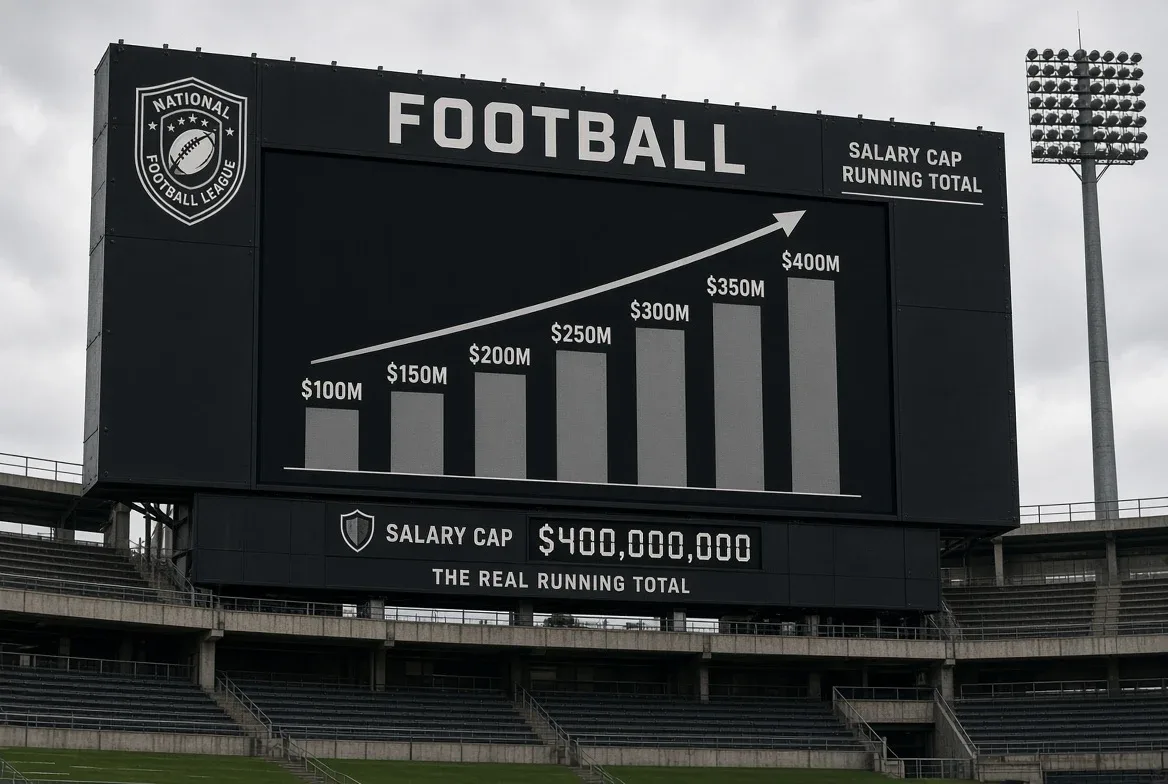
The NFL salary cap for 2026 is $301.2 million per team, up $22 million from 2025's $279.2 million and the first time the number has cleared $300 million, according to the league's own announcement to clubs on February 27, 2026. That jump isn't a guess or a negotiating tactic. It's the output of a formula written into the collective bargaining agreement: take the league's projected total revenue, hand players a guaranteed cut of it, subtract benefits, divide by 32. Everything else — the free-agency chaos, the cap-casualty press releases, the contract restructures — is downstream of that math.
It's worth sitting with how fast this number has moved. The cap was $208.2 million in 2022. It's $301.2 million now. That's nearly a 45% jump in four years, and per CBS Sports, the cap has more than doubled over the last decade-plus, with one notable dip: it actually fell from $198.2 million in 2021 to $182.5 million that same pandemic-shortened year before resuming its climb. Point being, this isn't a straight line up and to the right by accident. It moves with the money, in both directions.
Where does the cap number actually come from?
The NFL Players Association lays out the formula plainly: the league and union estimate "All Revenue" for the coming season, take roughly 48% of that projection, subtract estimated player benefits, and divide by 32 teams. "All Revenue" is broad by design — national and local broadcast deals, sponsorships, ticket sales, concessions, and licensing all count, while unrelated income like a stadium hosting a concert doesn't. The 48% player share is a floor set by the current CBA, and the union notes it can rise above that baseline depending on how new media agreements get valued.
That's the part fans tend to miss when they see a cap headline: the number isn't picked by owners trying to manage parity or the union trying to win a headline. It's a revenue-sharing outcome first and a competitive-balance tool second. When ESPN, Amazon, and the league's other broadcast partners sign bigger rights deals, the cap has to grow to reflect it, whether or not any particular front office is ready for that money.
Why does a bigger cap number matter beyond bragging rights?
Because it's not the only number that matters. Per the players association, clubs are also on the hook for roughly $40 million per team annually in benefits — health care, pensions, severance, and support for former players — money that sits outside the cap figure entirely. Add that to the $301.2 million cap and you get a real per-team spending floor well north of $300 million before a single marquee free agent signs an extension.
There's also a wrinkle that trips up casual salary-cap arguments: teams can spend more cash in a given year than the cap allows, because of how signing bonuses get prorated across a contract. A club chasing a title right now can push real dollars past the cap ceiling in the short term and pay for it later in dead money. That's the mechanism behind almost every "why did they cut that guy" story you'll read this offseason — it's rarely about the player's play. It's about where his cap number lands relative to the number the league just set.
What does the $22 million jump mean for this offseason?
In practical terms, every team walked into 2026 free agency with real new spending room that didn't exist the year before — CBS Sports flagged pending free agents like Trey Hendrickson, Daniel Jones, and Jaelan Phillips as players positioned to benefit directly from that extra flexibility. It also changes the shape of the argument teams have with their own stars. A quarterback or edge rusher angling for a new deal isn’t just negotiating against his own production anymore; he’s negotiating against a cap number that’s roughly 93 million dollars bigger than it was in 2022, per the league’s own historical figures. Agents know that math cold, and it’s a big part of why extension talks that stall in March sometimes get resolved by August, once a front office has mapped out how the new number fits its books.
How has the cap actually moved over the last few years?
| Season | Salary Cap Per Team |
|---|---|
| 2021 | 182.5 million dollars |
| 2022 | 208.2 million dollars |
| 2025 | 279.2 million dollars |
| 2026 | 301.2 million dollars |
Laid out that way, the pattern is hard to miss: a pandemic-driven dip in 2021, then a near-uninterrupted climb as national broadcast deals reset upward. Per the league’s football operations office, that 2021 figure is the low point of the modern cap era, and every full season since has set a new high, with 2026 the first to cross 300 million dollars outright.
That’s the honest through-line here: the cap number that gets announced every February isn’t really about any one team’s roster construction. It’s the receipt for how much money the sport generated the year before, split the way the league and its players agreed to split it. Everything that happens in free agency after that announcement, the extensions, the cap-casualty cuts, the restructures, is just 32 front offices figuring out how to spend a pie that got bigger again.
For a related athletes perspective, read How MLB Salary Arbitration Actually Decides What a Player Is Worth.
For more context, read Why ESPN Made Less Money From a Record NBA Season.
For more context, read Why ESPN Made Less Money From a Record NBA Season — Analysis.
For more context, read Why NFL 'Voluntary' Workouts Aren't Really Voluntary At All.